Improving insights into soil, vegetation, and environmental conditions across Europe
Agricultural and natural landscapes are strongly influenced by land surface conditions such as soil moisture, vegetation health, and energy exchanges between land and atmosphere. These factors affect both emissions and ecosystem functioning.
This is where SURFEX LDAS-MONDE comes in. It helps simulate and monitor these land surface processes by combining observations and modelling. Within GreenEO, it supports a better understanding of how land conditions influence agricultural emissions and environmental impacts.
Linking land conditions to environmental change
Agricultural and natural ecosystems are highly dynamic, and their environmental behaviour depends on complex interactions between soil, vegetation, and weather conditions.
A key challenge is that these land surface processes are difficult to observe continuously at large scale. Yet they strongly influence emissions, water cycles, and ecosystem health.
SURFEX LDAS-MONDE addresses this by improving our understanding of land surface conditions and their evolution over time, helping to better connect agricultural activity with environmental impacts.
What SURFEX LDAS-MONDE is
SURFEX LDAS-MONDE is a land surface modelling and data assimilation system that simulates soil, vegetation, and energy exchanges between land and atmosphere.
It is developed within the SURFEX modelling framework and used in environmental research to improve understanding of land surface dynamics. Within GreenEO, it contributes to the Agricultural emissions and biodiversity focus areas.
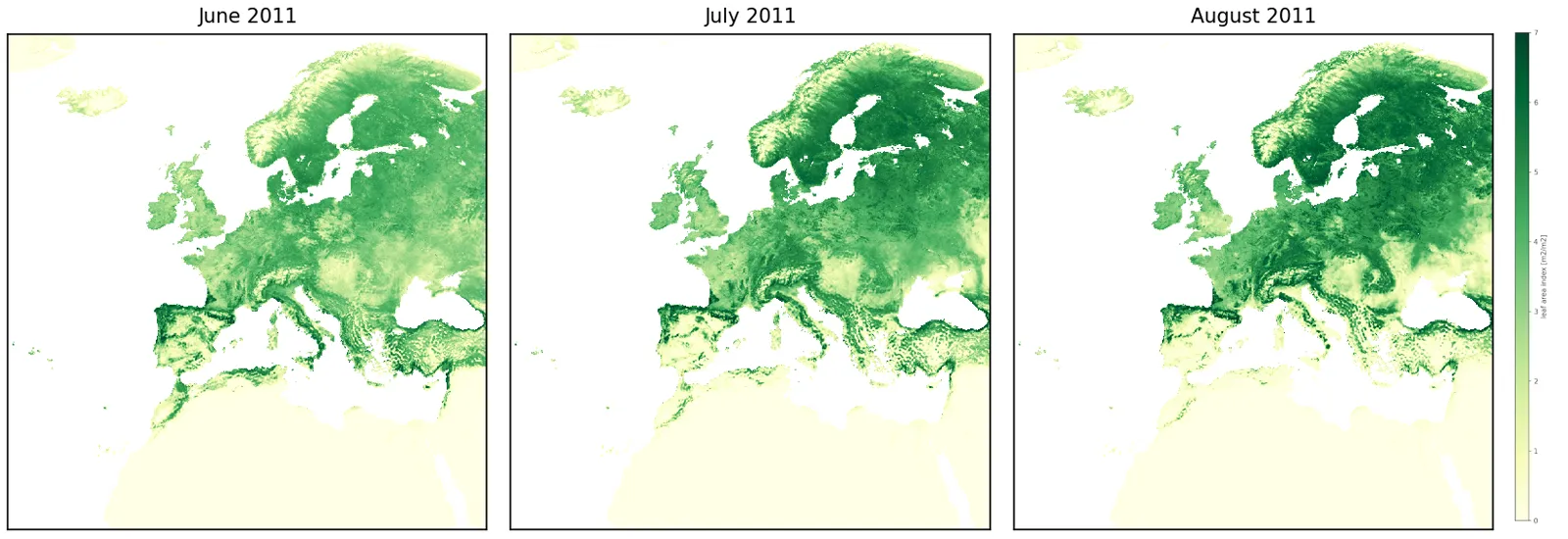
Figure: Europe-wide map of leaf area index during June (left), July (middle), and August (right) of 2011. Units: m-2.m-2
Understanding land and ecosystem conditions
SURFEX LDAS-MONDE helps describe how land and ecosystems behave over time by providing information on key conditions such as soil moisture, vegetation health, and how energy is exchanged between the land and the atmosphere.
These conditions are important because they influence agriculture, water availability, and ecosystem health. The model creates a consistent view of how these variables evolve across large regions and over long periods, making it easier to monitor environmental change.
To produce this information, the model combines satellite observations with a physical understanding of how land systems work. Satellites provide snapshots of vegetation and soil conditions, but they cannot capture everything continuously in space and time. SURFEX LDAS-MONDE fills these gaps by using knowledge of how soil, vegetation, and weather interact to estimate what is happening between observations.
For example, during a prolonged dry summer, the model can show how soil moisture decreases across agricultural areas and how vegetation gradually becomes more stressed. This helps identify drought development early and understand its potential impact on crops and ecosystems.
In simple terms, it builds a continuous and complete picture of land conditions by combining real-world measurements with a scientific understanding of how the land surface behaves.
A detailed view of land processes
SURFEX LDAS-MONDE is valuable because it provides a consistent and physically based representation of land surface processes at large scale.
It helps link environmental conditions such as soil moisture and vegetation stress with broader impacts on emissions and ecosystem health.
This makes it useful for understanding agricultural systems in a changing climate.
Supporting land–atmosphere analysis in agriculture
Within GreenEO, SURFEX LDAS-MONDE is used in the Agricultural emissions and biodiversity focus area to improve understanding of land surface conditions and the environmental impacts of agricultural activity and climate change.
It complements atmospheric models by providing key information on soil and vegetation dynamics that influence emissions and ecosystem processes.
Curious about what is next?
Stay up-to-date on GreenEO’s research and results, by following us on LinkedIn