Linking emissions, atmospheric transport, and ecosystem effects across Europe
Agriculture is a major source of the air pollutant ammonia, which contributes to fine particulate matter through atmospheric chemistry processes and affects both air quality and ecosystems. These impacts can extend far beyond the place of emission.
DECSO, EMEP, DEHM, OML-DEP and uEMEP help track and model these emissions and their transport in the atmosphere at different scales. Within GreenEO, they support a better understanding of how agricultural activities influence air quality and environmental health across Europe.
Adressing invisible and transboundary agricultural pollution
Agricultural emissions, especially ammonia from fertilisers and livestock, are diffuse and highly variable in space. And because emissions vary so much from one field or farm to the next, a single measurement is only representative of a very small area, making it difficult to build a reliable picture at regional or national scale from ground measurements alone.
For example, ammonia typically deposits or reacts with other atmospheric gases within minutes to days, forming fine particles. These particulates, unlike the ammonia itself, can stay airborne for weeks and travel hundreds of kilometres, meaning agricultural emissions in one region can affect air quality far from their source.
This makes it challenging to link emissions to their impacts on air quality and ecosystems. DECSO, EMEP, DEHM, OML-DEP and uEMEP help address this by estimating emissions (DECSO) and modelling how pollutants spread (EMEP, DEHM, OML-DEP and uEMEP), helping to reveal their wider environmental effects.
What are DECSO, EMEP, DEHM, OML-DEP and uEMEP?
DECSO is a system that estimates air pollutant emissions by combining satellite observations and inverse modelling. EMEP and DEHM are European-scale atmospheric models that simulate how pollutants move and change in the atmosphere. OML-DEP and uEMEP are also atmospheric models but they focus on a smaller spatial scale to give more detailed results.
All of them are used within GreenEO to support the Agricultural emissions and biodiversity focus area.
From agricultural emissions to atmospheric impact
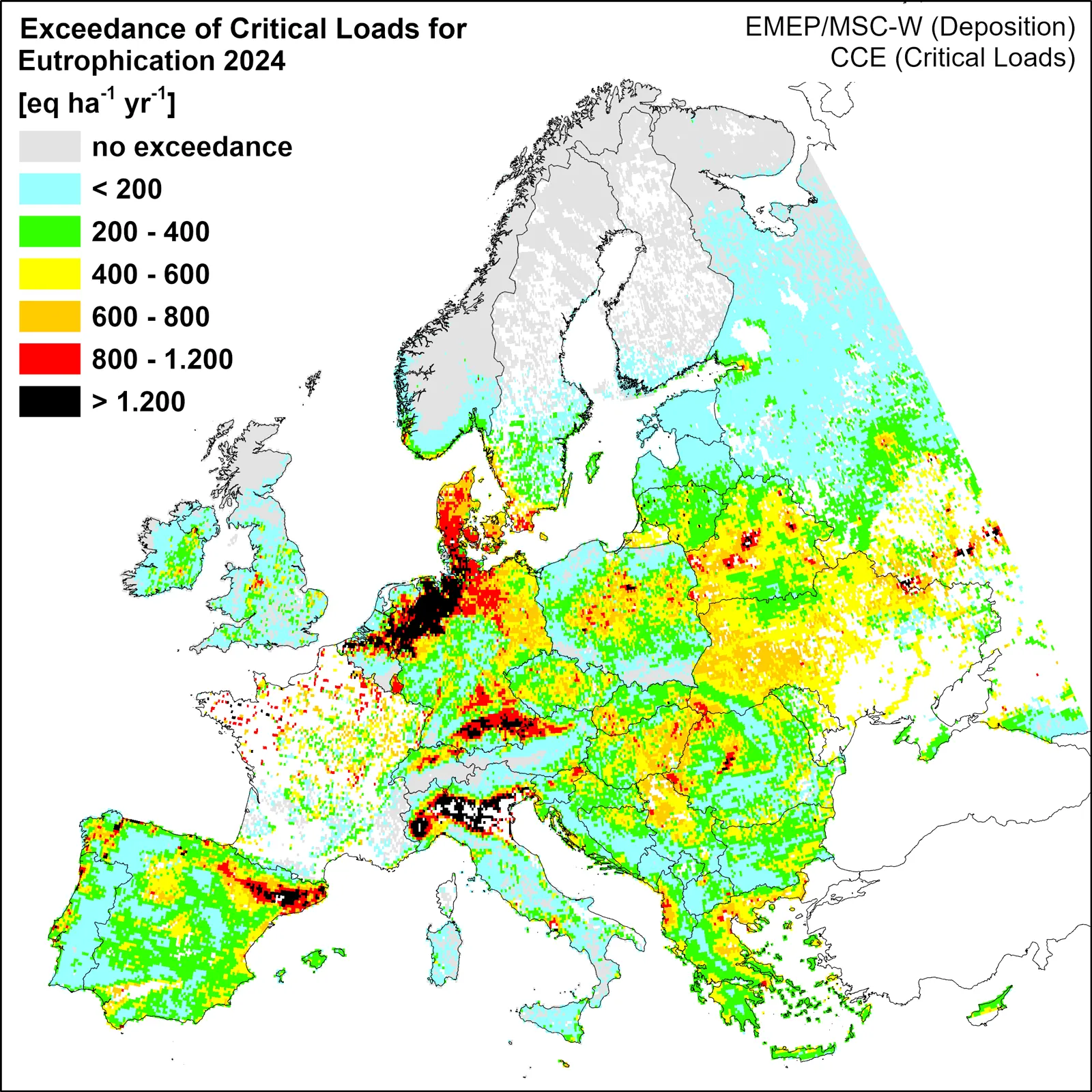
Figure: EMEP-Modelled Deposition Exceeding Critical Loads for Eutrophication, 2024
DECSO helps understand how much pollution is produced by agricultural activities and where it is likely coming from. Traditionally, emissions are estimated using bottom-up activity-based inventories, based on data farmers report, such as livestock numbers or fertiliser use, combined with standard emission factors. This approach is thorough, thanks to EU reporting obligations, however, relies on annual, self-reported figures that can't be independently verified.
DECSO takes a different approach: it uses satellite observations of atmospheric concentrations, combined with inverse modelling, to estimate the emissions that must have produced those concentrations. This reflects the actual situation on the ground, rather than relying only on what was reported.
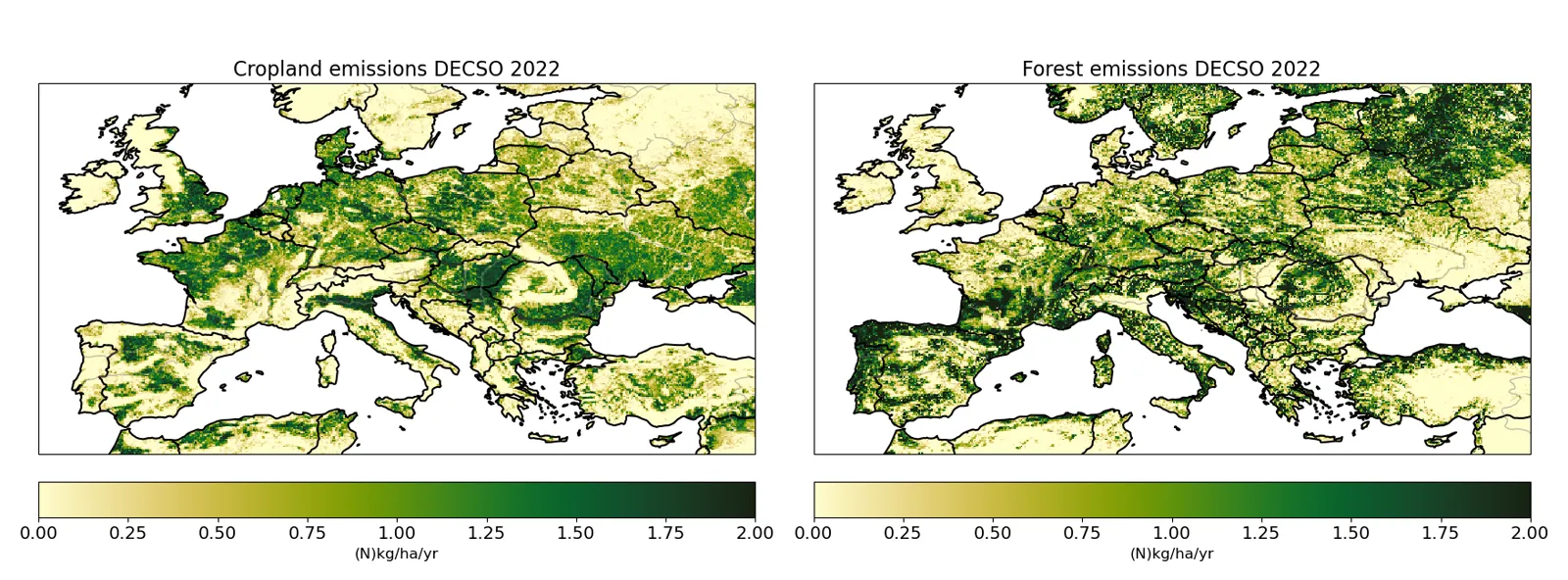
Figure: DECSO NOx emissions from cropland (left) and forest (right) in 2022.
EMEP, DEHM, OML-DEP and uEMEP complements this by showing what happens to these emissions after they are released. It explains how pollution moves through the atmosphere, can travel long distances, and eventually affects air quality, ecosystems, and even other countries.
Together, the five models provide a complete picture: where agricultural pollution originates and how it spreads across Europe at regional and local scale.
For example, ammonia released from fertiliser use in one farming region can later contribute to fine particulate pollution in cities hundreds of kilometres away. DECSO helps identify that the emissions likely come from agricultural activity in that region, while EMEP and DEHM show how they are transported through the atmosphere and where they eventually affect air quality. OML-DEP and uEMEP also show where the pollution from agriculture affects ecosystems.
In simple terms, DECSO helps answer where pollution comes from, while EMEP, DEHM, OML-DEP and uEMEP help explain where it goes and what it affects.
Connecting emissions and environmental impact
The strength of DECSO, EMEP, DEHM, OML-DEP and uEMEP lies in linking emissions to atmospheric transport and the settling of airborne nitrogen onto ecosystems, which can harm nitrogen-sensitive habitats.
This allows a better understanding of how agricultural activities affect air quality and ecosystems nationally and across borders, supporting evidence-based environmental policy.
Supporting agricultural impact insights
Within GreenEO, DECSO, EMEP, DEHM, OML-DEP and uEMEP are used in the Agricultural emissions and biodiversity focus area to analyse emissions and their environmental impacts.
They help translate agricultural activity into information on air pollution and ecosystem exposure across Europe.
For example, two of the outcomes the project is to develop detailed Europe-wide maps of ammonia emissions and nitrogen deposition, including information about where the tolerance of sensitive nature for nitrogen deposition is exceeded. This information can help national and local public authorities understand where to place an effort to effectively reduce the impact of agricultural emissions.
Curious about what is next?
Stay up-to-date on GreenEO’s research and results, by following us on LinkedIn